Thursday, 23 June 2011

Marple

It was a very wet morning as we set off.


We still had ten locks to go on the Huddersfield. After dropping down four we arrived in Stalybridge where we were able to moor right beside Tesco - its car park is partly on the other side of the canal. We did a little bit of shopping including buying some croissants - which provided a good accompaniment to the next mug of coffee.


Although the town centre does not perhaps live up to the glorious description given for it in Nicholsons, the restoration of the canal to boat traffic has certainly made a considerable difference. We understand that at one time when the canal was closed, this section was barely visible underneath factories and other industrial developments.


After completing the remainder of the locks down to Ashton Junction we had finished the Huddersfield and now on the Ashton Canal for the short distance that it takes to arrive at Dukinfield where we turned left onto the Peak Forest canal.


Bridge 1 is a lift bridge and, as it was still raining very hard, we opted to pull in to the bank for a lunch break and another of Christine's warming soups.


It was now a level pound for several miles and so only one person at a time needed to suffer the rain!

Along the way we passed a horse-drawn narrowboat - complete with horse and crew in costume. The horse boating trust keep this particular tradition alive and also some of the specific skills which are needed when a boat has no engine. The set off shortly after we passed them and they followed us for the rest of the afternoon.


Shortly before the Marple flight comes the Marple Aqueduct which carries the canal high over the River Goyt. The valley is so well populated with trees that it is difficult to see the stone arches themselves - although the parallel railway bridge is easier to see.


Just before four o'clock we were at the bottom of the Marple 16 and soon the sun came out and the rest of the afternoon was pleasantly warm and sunny. The first few locks were slow as a number of top paddles were not working. However the top part of the flight was much better and we made steady progress to the top lock.


One lock which has a bridge just below it, has a separate tunnel for the horse. The access for the boatman is even smaller!

Whilst Mike went on to the service station, just around the corner onto the Macclesfield, the others went to take photos of the horse boat and to find out a little more about what they do. Maria was built in 1854 at Marple and named after the builder's daughter. It is said to be the oldest narrowboat still in operation on the system. The horse is 17 and has been doing this job for 4 years.


The first bridge on the Macclesfield is a classic design of turnover bridge, several of which can still be found on this canal. They enabled horses to pass from one side of the canal to the other without having to untie the tow rope.


11.8 Miles - 25 Locks

Wednesday, 22 June 2011

Standedge Tunnel Day

Today is the day! We were ready for the tunnel briefing on time but the BW staff were in no great hurry and, despite the official bookings, we were to leave first as soon as the 'shadow' van was in place in the old rail tunnel.


Our pilot, Fred, briefed us and dressed Mike, as steerer, in safety gear - the hard hat definitely came in handy at several places in the tunnel.


8:54 and we were off. The pilot was extremely helpful - as well as giving a continuous commentary - making sure that, as far as possible, we avoided the worst of the rocks protruding into the path of boats. Every so often he checked with his shadow colleague in the other tunnel as there are numerous inter-connections.


At times the tunnel takes an s-bend and we had to slow down but otherwise progress was steady. At the final cross adit we had to stop for a short time to allow the pilot to report back to tunnel control - the shadow had by now turned back to follow the other boat which was passing through today, behind us.


The last part of the tunnel is a flat-roofed extension built when the last railway tunnel was built and allows both tracks to pass over the canal tunnel entrance.


Inevitably we had a few contacts and some resulting scratches - we would have been a bit more concerned if it were not for the fact that Take Five is booked in for a re-paint next month.


About an hour and forty minutes we emerged at the other end, again close to the railway line - we had heard a number of passing trains when we were in the tunnel and also felt them as they cause a pressure wave which is felt as a rise in the 'wind'.


After a time to recover from the experience we bade farewell to our pilot - we felt that we deserved our certificates! - and set off once more, now heading downwards.


The lock mechanisms this side are quite different in design - almost as if a totally different company!


There was plenty of water coming down the canal, although some sections are shallow. We dropped down the first flight of 8 locks to the Wool Road Transhipment Warehouse where we moored to use the sani station as well as have lunch.


The afternoon was very pleasant - the weather was warm and occasionally sunny spells, just right for a well-locked canal. The locks proved generally easy to operate and it was somewhat of a surprise to realise that we had come down 21 locks by the time we moored just below the short Scout Tunnel.


There were many former mill buildings - some have found limited additional uses - one with the sign: "Artist Studio" in a top floor window that looks out over the moors no doubt offers some quirky inspiration. Even the new build housing looks like the old mill architecture.


8.6 Miles - 21 Locks

Tuesday, 21 June 2011

Standedge

We anticipated a possibly difficult stretch ahead - we knew that we had to be at the top lock before 4 pm, that Andrew had quite a bit of trouble and delay when he came this way two years ago and also that there was a good prospect of frequent rain! As a result we set off just after eight with only two miles to go but 18 locks!


Although the lack of water depth meant that some pounds were very slow to navigate, almost all of them were as full as possible, with plenty of water going over the weirs into the bywashes.


Apart from several very heavy rain showers, interspersed with drizzle, it was a steady climb with the Pennines becoming ever closer.


One large but derelict, mill building had large notices declaring that it was being seized by a Receiver. Judging by the names of the parties involved, it seems possible that someone had thought that it would make a good apartment conversion but that the project had somehow failed. In any event, it was a sorry sight.


About half way we passed ?? reservoir which is one of the important feeds for section immediately below - although with the recent rain we saw numerous streams emptying into the canal.

Some three and a half hours later we arrived at the top, somewhat surprised that we had not encountered any especially difficult problems!


We tied up at the bollards just above the locks - for once there was enough water to come alongside - so that we could wander along the towpath up to the visitor centre and tunnel entrance.


A trip boat was just about to set off into the tunnel.


The Standedge Visitor Center contains an interesting history both of the original canal construction and its commercial operation, as well as its recent restoration.


Back at the boat we had lunch before Andrew set off to explore up the valley and see how the Yorkshire Water reservoirs are faring and a little later Mike and Christine walked into town to do a little shopping.


The splendid Mechanics Institute building is a measure of the town's important mill industry in the past, now sadly all gone. It is a compact town, more a large village which once had its own employment, the hills are never far away.


Back at the boat again, Christine stayed to read (aka sleep) whilst Mike wandered down the flight to take photos of the locks he missed on the way up as it was raining so heavily. By now sunshine appeared for a while and it was tolerably warm.

At lock 38E he discovered that the short pound above lock 37E was almost completely empty so he called up Andrew and he brought down a lock key so that we could check the relevant paddles. Since all the locks from 42E down to 34E were completely empty, lock 33E was full and all the other pounds were overflowing, it was not a little mysterious. Anyway, we found that one top paddle was a fraction of a turn up and when we pressed it tight the water level started to rise quite quickly. Whether it was down to us we cannot tell but we cannot see how another boat can have gone down since there was only one that was already waiting at the tunnel when we arrived.


Finally, we moved the boat the short distance up to the tunnel entrance, along a very leafy stretch, with heaps of spoil from tunnel construction now covered in vegetation.

2.12 Miles - 18 Locks
Monday, 20 June 2011

Slaithwaite

Hoping for a prompt start with the arrival of BW staff around 8:30, Mike and Andrew went off early to the nearby Sainsbury store for some supplies. However, by the time they returned, local intelligence (ie the other boat that had been waiting here for a few days) told us about delays. A short distance above lock 1E a boat coming down was stuck in the old lock 2E chamber - probably caught on the old cill by low water levels. Phone calls had established that BW staff would arrive some time when they had let enough water down.
Faced with a delay, Andrew went in search of a small water pump (Maplins turned out to be Maplins Road!) and shortly afterwards, Christine went in the opposite direction having identified via Google an outdoor shop where she hoped to buy some more heavy duty sandals as her favourite pair were rapidly falling apart.

Of course, it was after only perhaps ten minutes that the lady on the other boat came to report that they had had instructions to commence up the flight and that we were to go ahead (they had a tunnel booking for Friday whilst ours is for Wednesday)


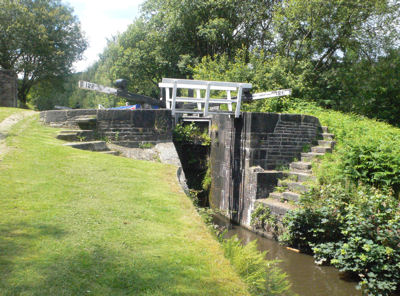
The boat down was now free and above the lock but was told to wait until Take Five had come up . . .

At this point, Mike's version of the story is under question by the rest of the crew who, when the returned to the boat at lock 4E (there is no towpath between locks 1E and 3E so they had to take a long diversion) clearly felt that they had been abandoned! In fact two BW staff were locking us through so there was little chance to stop . . .

It was a bright sunny day and at times became rather warm!


The pounds were all quite difficult to negotiate but after a while they were at least full. Progress was primarily impeded by the lack of depth to the water - probably because the restoration did not undertake enough clearance of accumulated silt and debris.


This situation is a shame. OK, so it is a complex management task to ensure that sufficient water enters the canal but the lack of depth means that even the smallest loss has an immediate impact and the navigability of the canal. In addition, the canal has less capacity so it does not act as its own reservoir to the extent that it should.

Nevertheless, we only had to run water down for a couple of adjacent very short pounds and before long there was excess water coming down over the bywashes - so much so in some cases that entry into the locks was made tricky by the fast cross current.


A short lunch stop was quickly halted when the following boat arrived at the lock behind us and we were soon on our way yet again. 


The scenery became increasingly rural, interspersed by the many mills which were built in this valley to create the once famous textile industry. Most are now turned to other uses - some allowed to decay into ruins but the most impressive is Titanic Mills (almost Blake!) which is now a huge block of apartments with an attached spa. Work on the development is still being finished although most of the space has been occupied for at least three years. The mill was so-named because it was opened in the same year that Titanic was launched!


At Slaithwaite we stopped briefly for the services but one water point has lost its connectors and the other was obstructed by a moored boat (whose crew seemed to think that they knew better than BW when it came to operating these locks - we had been asked to leave each lock emptying so that the boat behind us would have a better chance of having sufficient water to come through without running any more down)


 We moved on through Slaithwaite - at one point it really did feel that the canal had been converted into a ditch - and ascended the lock with a guillotine gate - again as result of having to re-negotiate a bridge which had been lowered when the navigation was closed.

Some of the locks here had many of the stone blocks used in their construction with very clear mason's marks (or so we presume)


BW had advised us of 'good' moorings above lock 24E - indeed the bollards were excellent. However, we did have to moor for the night some considerable distance away from the bank and use our gangplank (which rarely comes into play for this purpose.

5.2 Miles - 24 Locks